The Buyer’s Framework: How to Vet AI, Simplify Your Stack, and Protect Quality

How to vet AI vendors, simplify your ad tech stack, and never compromise on quality
Over the first three parts of this series, we made three arguments:
1 Most AI vendors sell with a demo. A demo is a test drive on a route the seller picked. To see past it, ask specific, written questions about how the AI works, what data it uses, and what happens when it gets something wrong.
2 Tool sprawl is a tax you pay every week. You pay it in time lost switching between tools, data that stays disconnected, and reports that disagree with each other. The fix starts with an honest audit of what your current tools cost you.
3 Consolidation comes in two kinds. Some platforms simplify by connecting strong capabilities. Others simplify by cutting the corners that made your work good.
This final post pulls all three into one framework you can bring to your next vendor evaluation. Print it, forward it to your team, or hand it to whoever owns the final decision.
The Buyer’s Scorecard
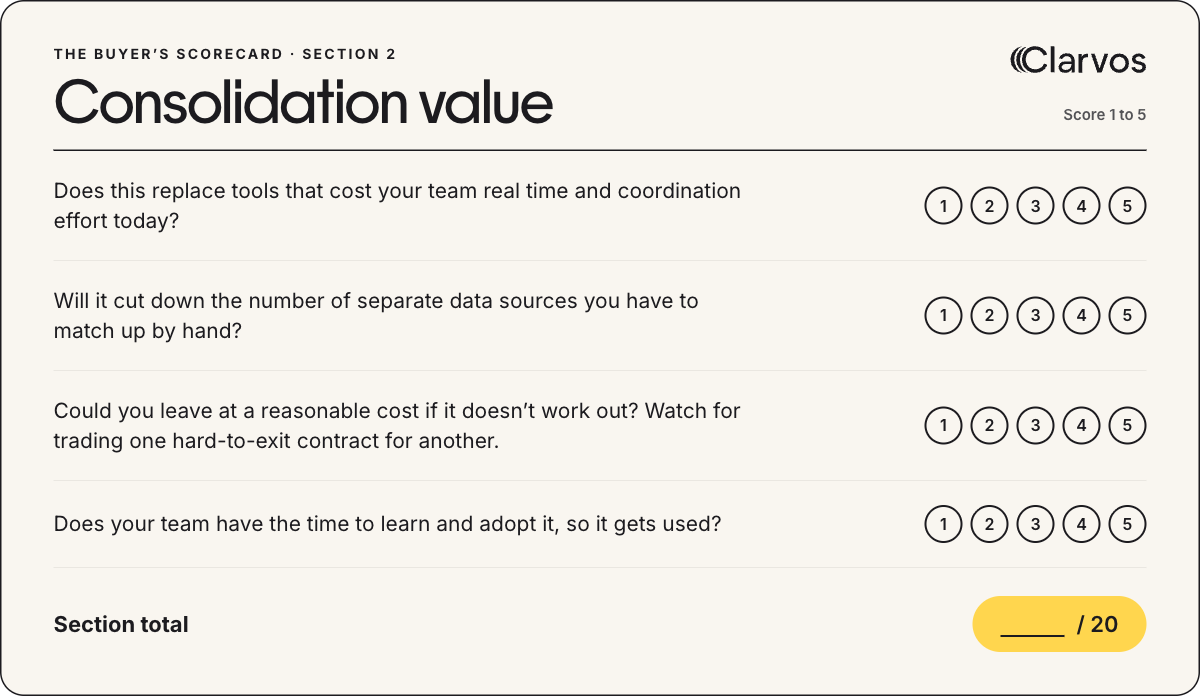
Score each vendor from 1 (fails badly) to 5 (excellent) in three areas. Think of it as a home inspection. The staging can look beautiful, and the inspection tells you about the foundation. A vendor that scores high on convenience and low on quality or transparency is telling you something important, however strong the pitch was.
1 Vendor Transparency (from Part 1)
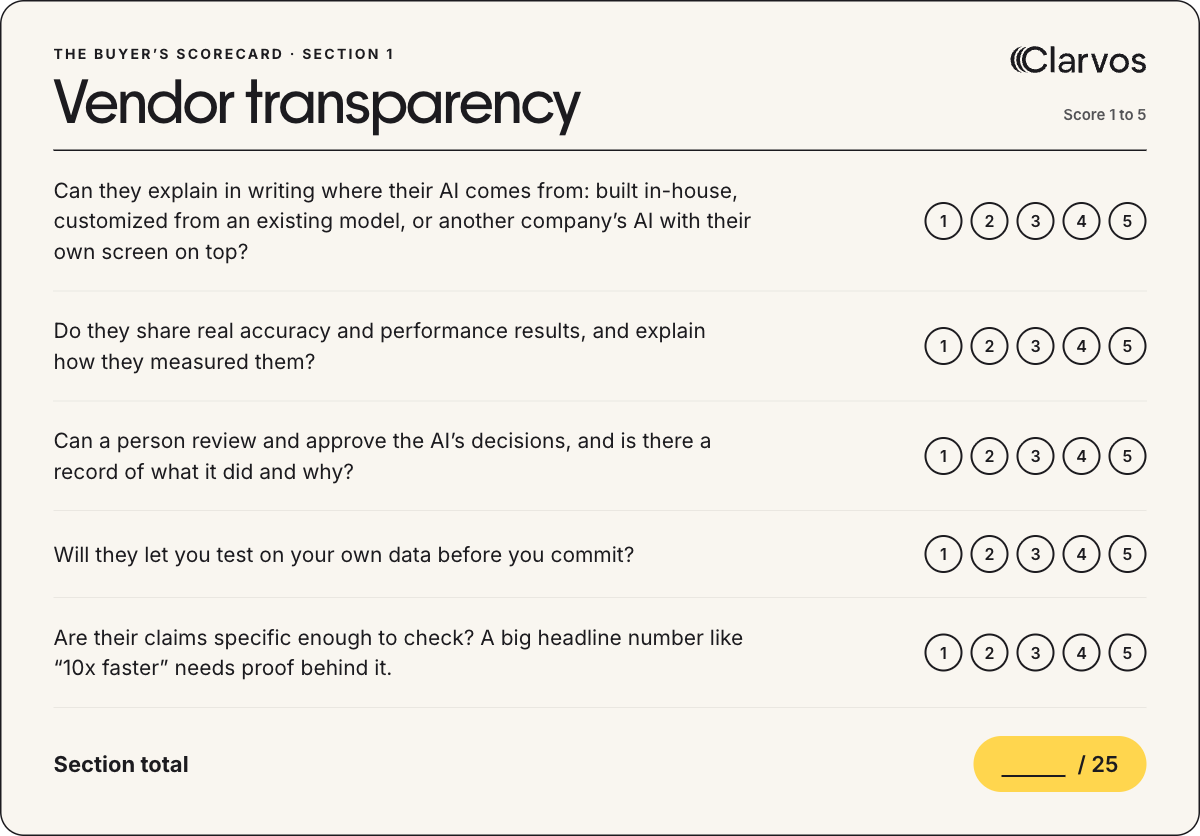
2 Consolidation Value (from Part 2)
3 Quality Protection (from Part 3)
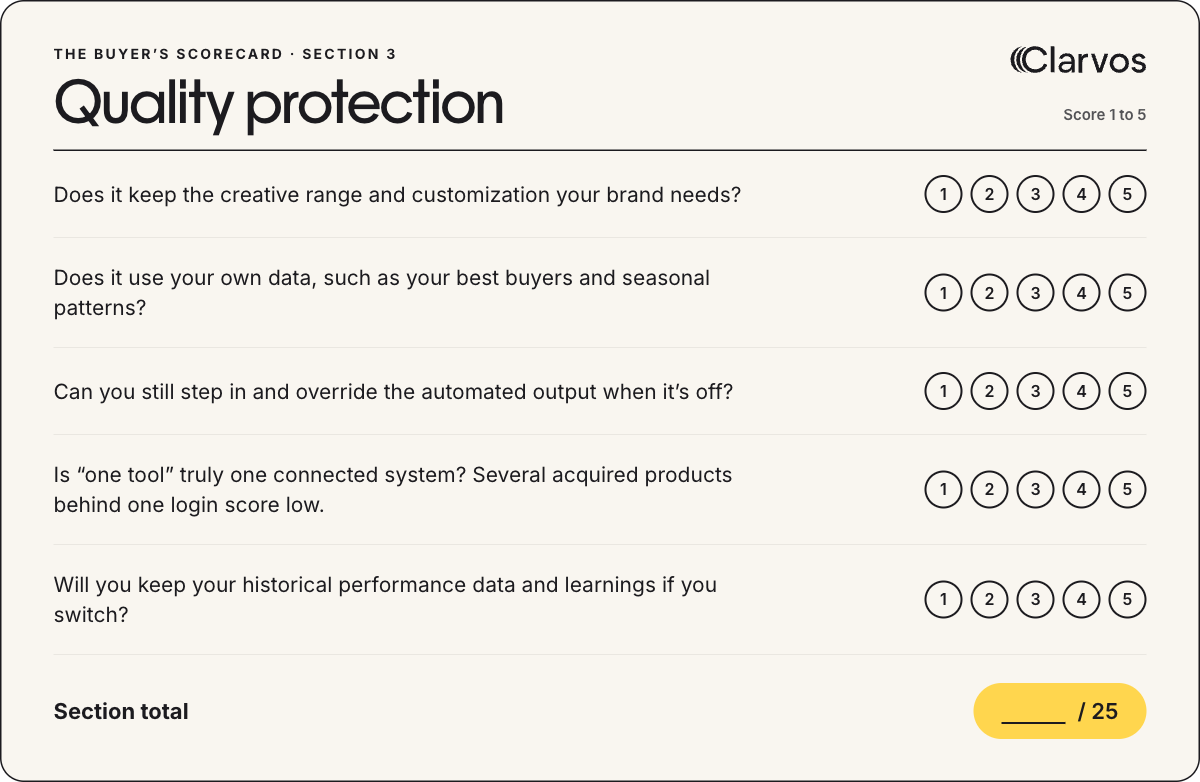
How to use the score: Read the scorecard like a report card. A vendor can be worth adopting without straight 5s. A strong average can also hide one failing subject. If any one area scores low across the board, especially Quality Protection, stop and dig in before you go further, no matter how impressive the demo was.
Questions to bring to your next vendor call
Print this list and bring it to the call. Notice which questions get direct answers and which get steered back to the pitch deck.
- What AI model powers this? Did you build it, customize an existing one, or are you reselling another company’s model with your own interface?
- What happens to our data? Is it used to train your AI, and can we get it back if we leave?
- Can we run this on our real account before committing? A test environment with sample data tells us much less.
- What specifically would we lose in capability or control compared with what we use today?
- Who on your side is responsible for making sure our output quality holds up over time?
- What do support and escalation look like when the automation gets something wrong?
If a vendor answers all of these clearly and specifically, that is a good sign. Most vendors have never been asked to be this specific, and how they respond tells you a lot.
Where this fits in your evaluation
Use this framework alongside your own evaluation process, your company’s purchasing requirements, and your team’s judgment about what your business needs. Its job is to keep the conversation on the three things that matter: transparency, real consolidation value, and protected quality. That keeps you in charge of the agenda, whichever vendor has the most polished demo.
The vendors worth your budget are the ones that hold up under this kind of scrutiny. That holds for a five-person startup with one sharp, single-purpose tool and for a large platform promising to replace half your stack.
Judge vendors of every size by how they answer these questions.
This is Part 4 of a 4-part series on evaluating AI vendors and building a smarter ad tech stack. [Read Part 1 →] [Read Part 2 →] [Read Part 3 →]
